


Should I Wear My Glasses All the Time? Benefits and Myths
Published on March 3rd, 2026
 Canada

There has been much discussion regarding the question ‘should you wear glasses all the time?’ Myths such as glasses potentially worsening vision and that they can lead to lazy eyes are some of the few that are often believed by hesitant wearers. However, the benefits of correctly wearing glasses, such as vision correction, improved safety, and reduced eye strain are true, and better for overall well-being. Read on to discover the benefits and myths of wearing glasses and how often they should be worn.
When Is It Necessary to Wear Glasses All the Time?
It is necessary to wear glasses all the time if an optometrist prescribes them for constant, daily correction. This will be the case if the wearer experiences refractive errors such as myopia, hyperopia, or astigmatism. Wearing glasses consistently is crucial if the wearer struggles to complete everyday tasks without them, such as driving and reading.
Do I Need to Wear Glasses All the Time for Specific Conditions?
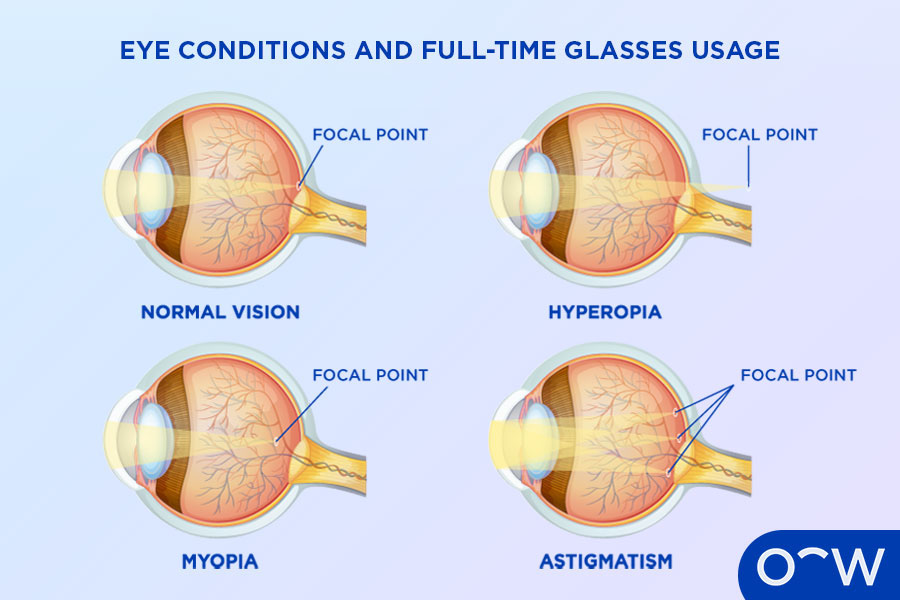
Yes, certain conditions will require people to wear glasses all the time. Those with myopia will need glasses to combat blurry long-distance vision, which can impact daily tasks such as driving. People with hyperopia will need to wear glasses to avoid headaches and fatigue that can come with viewing objects at a close distance. Astigmatism is mitigated by glasses, as they correct the distorted and blurry vision that comes with the condition.
Can Wearing Glasses Constantly Improve My Vision Over Time?
Wearing glasses constantly will generally not improve vision over time. Glasses do not reshape your eye structure or fix any underlying issues. They also do not weaken your eyesight over time if they are constantly worn. Rather, wearing glasses corrects vision, making everyday eyesight much clearer.
What are the Benefits of Prescription Glasses?
The benefits of prescription glasses include vision correction, reduced eye strain, and improved safety. Prescription glasses are corrective lenses worn to correct vision problems. Some of the benefits of prescription glasses are explained below.
- Vision correction: Vision correction is a prominent benefit of prescription glasses. A prescription lens refracts light onto the retina using either a concave or convex lens, depending on the vision condition. This helps to direct light onto the retina properly and helps with the symptoms of refractive errors, such as blurry vision.
- Reduce eye strain: Reduced eye strain is a benefit of prescription glasses. Eye strain can be a symptom for those who suffer from eye conditions such as hyperopia, as short-distance sight can lead to eye strain and headaches.
- Improved safety: Improved safety is a benefit that can occur as a result of wearing prescription glasses for better vision. Wearing prescription glasses for tasks such as driving is absolutely crucial for the wearer and others’ safety if they suffer from poor eyesight.
What Are the Risks of Not Wearing Glasses as Prescribed by My Optometrist?
The risks of not wearing glasses as prescribed by an optometrist include increased difficulty with everyday tasks, eye strain, and an increased risk of accidents. The risks of not wearing glasses as prescribed by an optometrist are explained below.
- Increased difficulty with everyday tasks: An increased struggle with everyday tasks is a significant risk when not wearing glasses as prescribed by your optometrist. Your prescription is given to accommodate your eyewear needs. Without wearing it, tasks such as reading, driving, and watching TV will become an increased struggle.
- Eye strain: Eye strain may occur if you do not wear glasses as prescribed. Glasses assist with clear vision, and without them, your eyes may strain to see clearly, leading to headaches and fatigue.
- Risk of accidents: There may be a risk of accidents when glasses are not worn when they should be. Whether you are driving or crossing the street, if you are not wearing the correct prescribed glasses, you could cause injuries to yourself or those around you.
How Can I Tell If I Need to Wear Glasses All the Time?
Some signs that you may need to wear glasses all the time include blurry vision, excessive squinting, and seeing halos. These symptoms indicate you might need to wear glasses more frequently and seek advice from an optometrist for a personalised eye assessment. The signs that you may need to wear glasses all the time are explained below.
- Blurry vision: Blurry vision can indicate fatigue or dry eyes. However, if blurry vision persists, it could indicate conditions such as nearsightedness or astigmatism.
- Excessive squinting: Excessive squinting can occur when your eyes are having trouble focusing, such as when you are reading or working on a laptop. This can impact your ability to do everyday tasks and potentially indicate hyperopia.
- Seeing halos: Seeing halos around various light objects, such as bulbs, car headlights, and street lamps, can indicate eye conditions such as cataracts and astigmatism. These symptoms may be corrected with prescription glasses.
Is It Safe to Avoid Wearing Glasses Occasionally for Short Periods?
There are certain situations where it is safe to avoid wearing glasses occasionally for short periods. For example, if you have hyperopia, you will need to wear glasses for reading but not for driving. Ultimately, it is best to consult an eye care professional regarding when you have to wear glasses and when you don’t have to.
Should I Wear Glasses During Specific Activities?
Glasses should be worn during specific activities, depending on your eye condition. For example, those with myopia should wear glasses while driving, as it requires robust long-distance vision. Hyperopia sufferers will need glasses for reading and computer usage, as the words are in close proximity to the eyes. Ultimately, your vision weaknesses and the regular activities you undergo will determine which specific activities you should wear glasses for.
What are the Myths About Wearing Eyeglasses for the Long-Term?
There are many myths pertaining to wearing eyeglasses for long-term periods of time, such as that they can fix all vision problems permanently, that they can lead to lazy eyes, and that children should only wear them when their eye problems become too severe. The myths about wearing eyeglasses for the long term are explained below.
- Eyeglasses can fix all vision problems permanently: Eyeglasses cannot fix all vision problems permanently. Corrective lenses do not cure vision problems, but simply improve your vision, according to optometrist Dr. Marianne Hopkins.
- Wearing glasses can lead to lazy eyes: The notion that wearing glasses can lead to lazy eyes is a myth. Lazy eyes refer to when there is reduced vision in one eye. Glasses correct vision, and do not cause eyes to become lazy. They help reduce eye strain and promote clear vision, not worsen it.
- Children should only wear glasses when eyesight becomes severely impaired: The Canadian Association of Optometrists explains it is estimated that only 14% of children under 6 years old receive professional eye care. They emphasize that the earlier a vision problem is diagnosed and treated, the less of an impact it will have on a child’s development.
How Do Different Eye Conditions Affect the Need for Full-Time Glasses Usage?
Different eye conditions and their severity will affect the need for full-time glasses usage. Those with myopia often require glasses for activities such as driving and going to the cinema. Those with hyperopia will mainly need glasses for close-up activities such as reading and computer work. Those with astigmatism will need glasses full-time to maintain visual clarity at all distances. Another condition that may require full-time glasses use is presbyopia, which is the gradual loss of the eye’s ability to focus on nearby objects, which will require the need for glasses when doing close-up tasks. Presbyopia usually becomes apparent between the ages of 40 and 45, according to the Canadian Association of Optometrists. In each of these common eye conditions, the severity will also factor in the need for full-time glasses usage. Ask your optometrist to confirm whether you require glasses for full-time use.
Can Lifestyle Changes or Eye Exercises Reduce My Dependence on Glasses?
Certain lifestyle changes can lead to reduced dependence on glasses. Many experts suspect that the surge in screen time has increased short-sightedness. There is evidence that the more time children spend reading up close, whether that is looking at a smartphone, tablet, or book, the higher the risk of developing myopia, according to the Canadian Ophthalmological Society. To combat this, it is important to have screen time limits, and if this is not possible, then practise the 20-20-20 rule. For every 20 minutes you spend looking at a screen, you look at something 20 feet away in the distance for at least 20 seconds. Eye exercises such as Figure Eight and Pencil Push Ups can also potentially strengthen eye muscles and improve blood circulation when done regularly.
Can Glasses Make Your Vision Worse?
Glasses do not make your vision worse. This is a common misconception when it comes to eyewear. Changes in vision are usually linked to factors like age, genetics, or eye conditions, not from glasses themselves, according to Dr. M. Hulbert. The misconception that glasses can deteriorate your vision comes from the belief that ‘forcing’ the eyes to concentrate without the assistance of glasses helps strengthen the muscles around the eyeball and slow the potential progression of refractive errors. Ultimately, this force will lead to eye strain, which can cause headaches and fatigue. However, wearing the wrong prescription can affect the eyes negatively. Consult an optometrist if you believe your prescription is too strong or too weak.
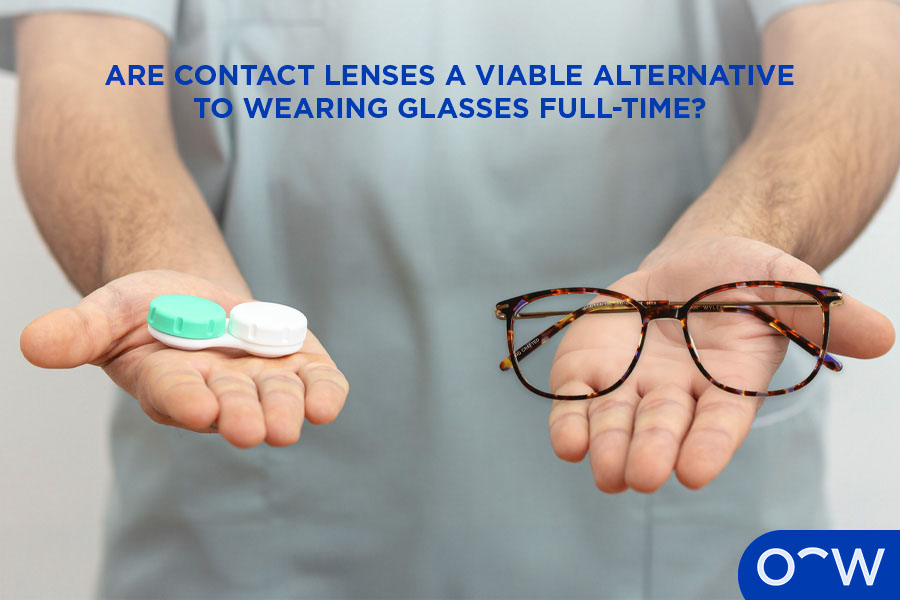
Are Contact Lenses a Viable Alternative to Wearing Glasses Full-Time?
Contact lenses can be a viable alternative to wearing glasses full-time. Contact lenses are a type of thin lens that sits on the surface of the eye and helps to correct vision issues caused by refractive errors. Unlike glasses, they are safe for sports and other physical activity, and well-fitting contact lenses can be more secure than glasses for these activities. However, more care is required when contact lenses are being used. Your hands must be clean when they are being handled, and the contact lenses must be stored in a clean environment. Many people may take time to adjust to the feel of using contact lenses as they sit on the eye. You may want to consult an optometrist to gauge the suitability of wearing contact lenses. It is important to note that Oscar Wylee does not sell contact lenses.
Do Children Have Different Requirements for Full-Time Glasses Usage Compared to Adults?
Children have different reasons as to why they may require full-time glasses compared to adults. Many have to wear them full-time as classroom tasks will require them. From reading the board to taking down notes, tasks such as these require clear eyesight. However, they may not need glasses for activities such as sports, depending on their eyewear needs. It is important to seek professional advice from an optometrist and book an eye exam for your child if there are changes in their vision.
Read Should I Wear My Glasses All the Time? Benefits and Myths in other Oscar Wylee regions and their languages.
Canada